No Assembly Required: How AI Finally Solved Biology’s 50-Year Puzzle
I hope everyone is doing well! I apologize for the delay in uploading this post. I’ve been busy with projects and new opportunities, but I’m excited to finally share this one. It’s a deep dive into one of the most groundbreaking papers in biology and AI: the original AlphaFold paper from 2021.
AlphaFold was published in 2021, the same year I started college! And I remember hearing about it in some random biology class and thinking: okay, this is a big deal. I didn’t fully understand why then. I do now.
Today’s paper: “Highly accurate protein structure prediction with AlphaFold” — Jumper, Evans et al. (Nature, 2021)
The Puzzle With No Box
Imagine a 3D sculptural jigsaw puzzle — not the flat kind, but one where the pieces come together into a real physical object, like a small building or a tiny, twisted sculpture. You have the list of pieces. You just don’t have the box, and the box is the only place the final picture was printed - so you have no clue what the finished sculpture looks like.
Now imagine billions of these puzzles sitting in a warehouse, each one with its piece list known, but no one knowing what the sculpture looks like.
That, essentially, was biology’s problem.
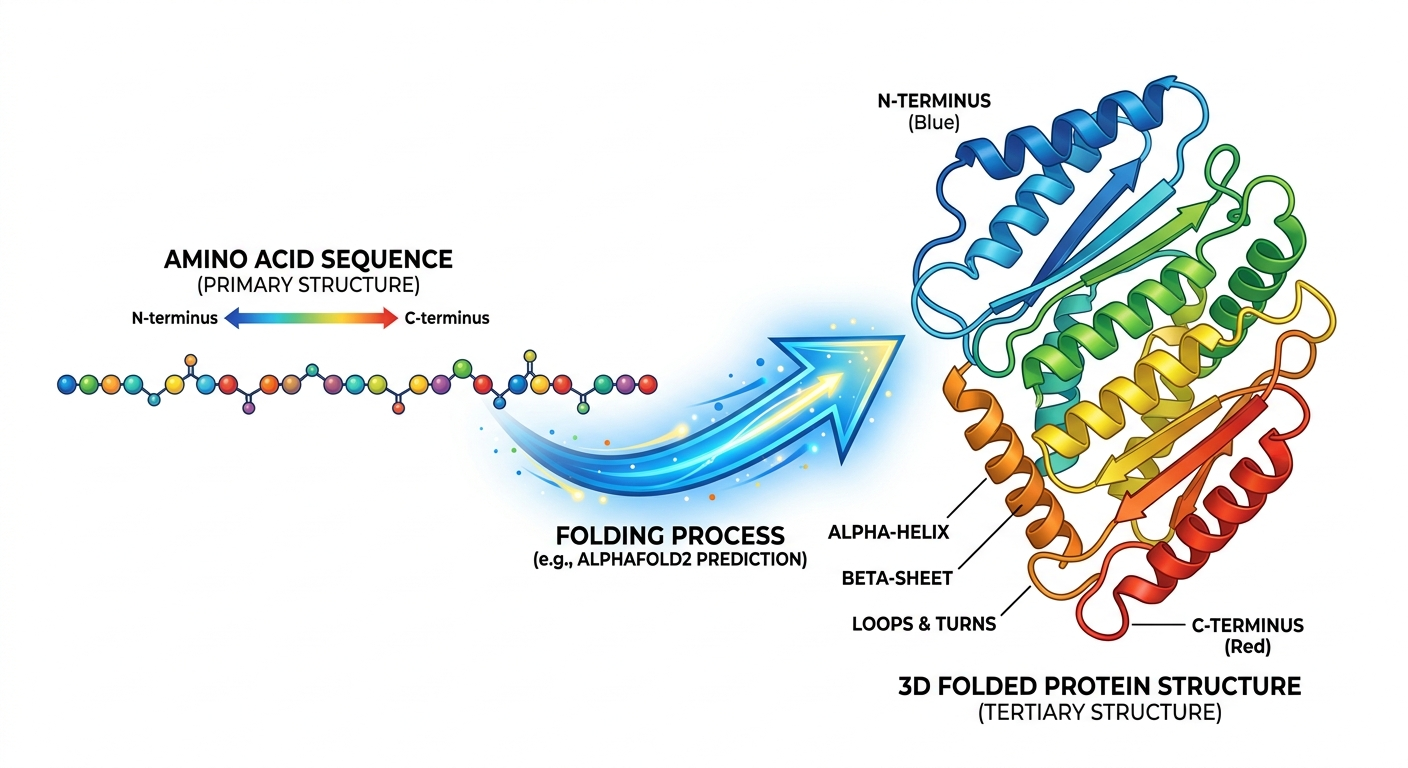
Every protein in your body is made of a chain of amino acids — the “piece list.” Scientists could read that list pretty easily. The problem? Just because you have a list of pieces doesn’t mean you know what the finished sculpture looks like.
Proteins don’t stay as flat chains. They fold into specific 3D shapes — and that shape is everything. Remember, form drives function. It determines what the protein does, how it interacts with other molecules, whether it causes disease, whether a drug can bind to it. Shape = function.
Predicting that 3D shape from just the amino acid sequence? That was the protein folding problem and it had stumped scientists since the 1970s.
Why Was It So Hard?
There are billions of known protein sequences. But we only know the 3D structure for a tiny fraction — around 100,000 out of billions. A single structure can take months or years of painstaking lab work (using X-ray crystallography, cryo-EM, or NMR) to determine. This gap is called the structural coverage bottleneck.
Two approaches exist for predicting structure computationally:
Approach 1: Homology Modelling “This new protein looks like one we already know — let’s copy that structure.” Works great, unless no similar protein exists in the database. Then you’re stuck.
Approach 2: Ab initio (From Scratch) Start from physics — thermodynamics, energy minimization, how atoms interact — and calculate the most stable fold. Theoretically perfect. Computationally brutal. Like trying to figure out the final sculpture by simulating the physics of every piece falling into place.
The CASP Exam: Biology’s Blind Test
Every two years, scientists hold a competition called CASP — the Critical Assessment of protein Structure Prediction. It’s a blind test: you get the amino acid sequence, you predict the structure, and a panel of judges compares your prediction to the experimentally determined structure that nobody else has seen yet.
In 2020, AlphaFold entered CASP14 and absolutely dominated everyone.
Its median Cα RMSD was 0.96 Ångströms — that’s the average distance between its predicted atom positions and the actual ones. For context, an O-H bond in water is about 0.96 Å. In other words, the error was roughly the size of a single chemical bond. The next-best method had an error of 2.83 Å — nearly three times worse.
For the first time, a computational method was producing results you’d trust as much as an actual lab measurement. And it could do this even for proteins with no known homologue — pieces with no relatives in the database. It was a game-changer.
The “Friends Across the World” Insight
Back to the puzzle. Here’s the key idea that makes AlphaFold work.
Imagine your friends in 500 different cities each have a nearly identical version of your puzzle. Same pieces, slightly different shapes — because evolution has been tweaking them for millions of years across 500 different species. But the final sculpture they all build is very similar.
Here’s the insight: if piece #34 and piece #89 change shape together across all 500 puzzles — when one friend’s piece #34 gets a bit rounder, piece #89 gets a bit flatter in the same puzzle — they’re probably touching each other in the final sculpture. Pieces that co-evolve together are physically close in 3D space.
This is the evolutionary logic AlphaFold runs on. You read these patterns using a Multiple Sequence Alignment (MSA): line up the same protein across hundreds of species, and look for positions that mutate together. The more species you have, the stronger the signal. (When you have fewer than ~30 aligned sequences, accuracy starts to drop.)
Meet the Evoformer: The Engine Under the Hood
AlphaFold’s architectural heart is a novel neural network called the Evoformer. Think of it as the algorithm that reads all 500 friends’ puzzle notes simultaneously and builds two things at once:
- The species-by-piece table (the MSA representation, Nseq × Nres) — evolutionary information across all species
- The piece-proximity map (the pairwise representation, Nres × Nres) — a grid tracking how likely each pair of amino acids is to be spatially close
The clever part? These two representations talk to each other inside the Evoformer. Evolutionary clues from the species table update the proximity map. The proximity map refines what the evolutionary table means. Back and forth, across 48 stacked Evoformer blocks, building up a richer and more consistent picture of the protein each time.
Triangular Attention: Geometry Has Rules
Here’s a neat constraint baked into the Evoformer. If piece A is touching piece B in the sculpture, and piece B is touching piece C — then pieces A and C can’t be strangers. They must be somewhere in each other’s vicinity.
This is just the triangle inequality of 3D space. You can’t have A-B close, B-C close, and A-C wildly far apart. It’s geometrically impossible.
The Evoformer enforces this through triangular attention — an attention mechanism that looks at every pair of residues through the “lens” of a shared third residue, making sure the proximity map stays geometrically consistent. It’s how the network bakes in the rules of 3D space before it even starts placing atoms.
The Structural Module: From “Who’s Near Whom” to Actual Coordinates
After 48 rounds of Evoformer processing, we have a very detailed map of relationships — but still no actual 3D coordinates. That’s the Structural Module’s job.
It takes the proximity map and MSA representation from the Evoformer and starts placing amino acids in real 3D space. Each residue gets its own local coordinate frame — a position plus an orientation, defined by the geometry of the N-Cα-C backbone atoms. Think of it as giving each puzzle piece its own tiny GPS tag telling you not just where it is, but which way it’s facing.
IPA: Attention That Doesn’t Care How You Tilt the Puzzle
The specific attention mechanism used in the Structural Module is called Invariant Point Attention (IPA). “Invariant” is the key word — the calculations are invariant to rigid rotations and translations of the whole protein.
What that means in plain terms: whether you look at the puzzle from above, from the side, or upside down, piece A is still two positions to the left of piece B. The relative geometry holds regardless of how you orient the whole thing.
FAPE: Checking from Every Angle
The final loss function, FAPE (Frame Aligned Point Error) checks how accurate the predicted atom positions are compared to the true structure. But it does this check from many different local frames simultaneously, not just one global view. It’s like verifying your assembled sculpture looks right from every direction at once, not just from the front.
Three Rounds of “Did I Get That Right?”
Once AlphaFold produces a structure, it doesn’t just stop there. It runs the whole thing through the network three times — each pass taking its own output as input and refining it. This is called recycling: build a structure, feed it back in, spot and fix inconsistencies, repeat. The final structure is the third-pass answer.
The Results
When the backbone prediction was accurate, the side-chain modeling was accurate too — suggesting the network was learning real structural principles, not just memorizing. It extended cleanly to a large PDB dataset of recently deposited proteins it had never seen during training.
It even worked on genuinely difficult cases: intertwined proteins, those that only fold in the presence of another molecular domain, and long chains with no known relatives anywhere in the database.
Final output: exact 3D coordinates for every heavy atom in the protein — in minutes to hours, not months in a wet lab.
One More Thing
And it’s not stopping there. AlphaFold3 (2024) has since extended the approach to protein complexes, DNA, RNA, and small molecules — now using a diffusion-based model. The full picture of molecular biology is slowly coming into focus.
We went from a 50-year unsolved problem to predicting nearly any protein’s structure in hours. The puzzle was always solvable. We just needed to learn how to read the clues evolution had been leaving for millions of years.
Want to discuss this paper? Have questions? Reach out!
📧 Email: devansh.shah@iitb.ac.in
Feel free to share your thoughts, corrections, or follow-up questions. We’d love to hear from you!
References
- Jumper, J., Evans, R., Pritzel, A., et al. (2021). Highly accurate protein structure prediction with AlphaFold. Nature, 596, 583–589. https://doi.org/10.1038/s41586-021-03819-2
- Jumper, J., et al. (2021). Applying and improving AlphaFold at CASP14. Proteins, 89(12), 1711–1721. https://doi.org/10.1002/prot.26257
- AlphaFold Protein Structure Database: https://alphafold.ebi.ac.uk/
- CASP14 Results: https://predictioncenter.org/casp14/
- AlphaFold and Ikea: https://buxtonosteopathy.co.uk/alphafold-how-proteins-organise-themselves/
- AI-generated image. (Gemini)